
Contents
How Dissertation Writing Services Work – The Entire Process
Dissertation writing is an important prerequisite within Singaporean universities. Students pursuing undergraduate and postgraduate courses across various reputed universities in Singapore like NUS, NTU, SIT, SMU are required to undertake dissertation to successfully complete their graduation. But writing a dissertation is a very complex and time taking process, as it includes selection of topics to perform literature analysis, collecting data to analyse and summarising and final proofreading.
It not only requires time but significant effort in terms of high-level research work, compliance with academic guidelines, and regular interaction with dissertation supervisors. Along with this, you can learn other factors that makes it essential for students to hire professional dissertation helpers. But how do these services actually work? What happens behind the scenes? Who are the actual writers and how do they approach each stage of your dissertation?
This blog post provides step by step breakdown of how these dissertation writing services operate to deliver high quality work to students.
Top Quality Dissertation Writers Available to Help
 PhD Level Dissertation Experts
Native Singaporean Writers
24*7 Available
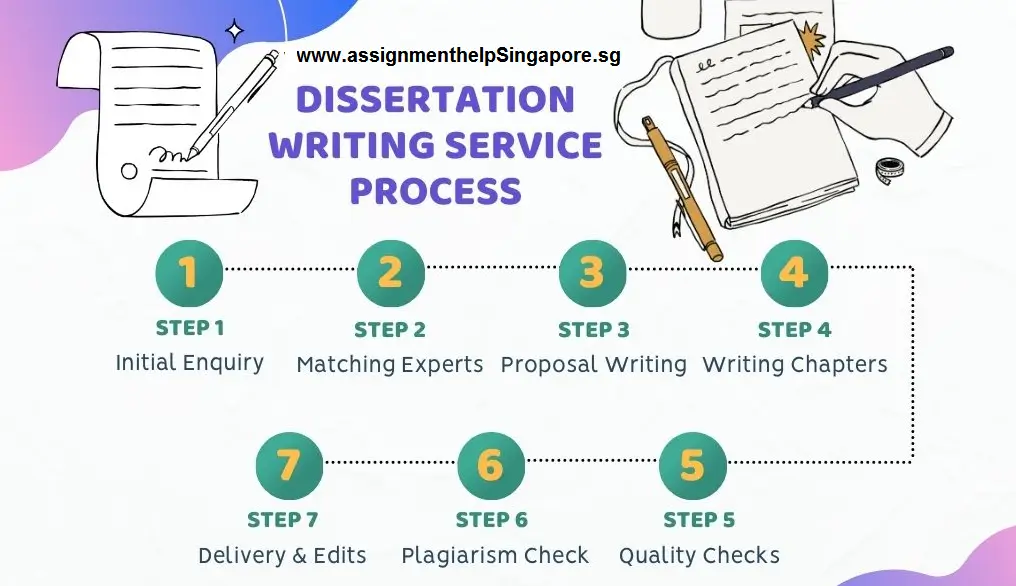
Steps Followed in Crafting a High-Quality Dissertation
The process starts with getting an inquiry from a student about writing a dissertation and it ends up with editing and proofreading of the final piece of work, and amendments if required. These steps are explained as follows:
Initial enquiry and requirement submission:
The process starts with students reaching out to us with their topic and request to craft a dissertation from scratch. We expect you to typically provide us with:
- The topic for your dissertation or the research area or research proposal if you have completed it.
- University guidelines specifying your dissertation requirements.
- Dissertation length such as word count/page limit, and deadline.
- Preferred referencing style to use.
At this stage, the main focus is on collecting information so that your dissertation can be completed as per your requirements and expectations.
Matching experts according to topic/subject area:
Once the dissertation topic/subject area is received, the next stage is to find the most appropriate expert that can complete your dissertation with perfection. The expert allocation is carried out considering the subject, difficulty and academic level. As for example:
- An accounting dissertation is assigned to an accounting expert having knowledge of finance and accounting theories and calculations.
- An expert from nursing/ midwifery background is utilised to carry out a nursing dissertation.
- Similarly engineering topics are matched with technical writers.
The focus at this stage is on allocating the dissertation to the most relevant expert who has subject specific knowledge, required abilities and experience to craft a perfect dissertation.
Proposal development if required:
If the proposal is already prepared and you got it approved, then there is no such need for writing a research proposal. It is only required if it’s not done already, and experts can help you with:
- suggesting a few topics to get preliminary approval.
- start crafting the proposal on topic acceptance.
- specify research aim, objectives and questions.
- propose appropriate methodology depending on the topic.
- writing a full proposal as required by the university.
Universities in Singapore require approval from the supervisor before proceeding to start working on the final research.
Start the actual writing process:
The actual writing process starts once the proposal is approved. As dissertation has many chapters, each chapter is crafted with patience and perfection as follows:
Chapters Included in Writing A Dissertation in Singapore!!
 Introduction Chapter With Research Aim, Objectives & Questions
Literature Review Analysis With Literature Gaps Identification
Research Methodology Writing With Data Collection Methods Used
Data Analysis Using Appropriate Tools and Techniques
Conclusion and Recommendatiosn Drafting With Actual Findings
References and Appendix Sections Covering Sources and Additional Info
a) Introduction chapter: The introduction chapter is written by taking most of the details from proposal which includes:
- Background details
- The research aims and objectives
- The research questions
- Rationale and justification
b) Literature review: The expert makes use of credible sources in writing up the literature review. The main focus is on critically analysing the literature to explore the research gaps which forms the basis for the research. The expert make use of:
- Peer reviewed journal articles
- Academic books
- University databases and library resources
- Google scholar and reputed journals
Once the gaps are identified, the researcher aims at connecting them to your research objectives
c) Research methodology: The researcher highlights the methods followed in collecting data in the methodology chapter. It includes a detailed explanation of
- Research design
- Research approach,
- Type of research,
- Sampling method,
- Tools/instruments utilised like questionnaire, interviews etc,
- Data collection procedure, and
- Ethical considerations made.
The focus of the researcher is on clearly explaining the process followed in data collection.
d) Data analysis and discussion: Researcher performs the analysis of data collected from different sources using appropriate tools and techniques. If it is quantitative research, the researcher makes use of SPSS, STATA, R, excel statistical analysis, regression model, descriptive & inferential statistics etc. If it is qualitative research, the researcher makes use of thematic analysis, coding, NVivo analysis etc.
The findings are presented appropriately with critical discussion carried out by relating it with literature review findings.
e) Conclusion and recommendations: The researcher finally makes use of the findings from the research to craft your conclusion and recommendation chapter. The research will starts with:
- Restating the main aim of the research with brief background details.
- Specifying research questions and providing answers to each based on research findings.
- States research limitations if any
- Include recommendations based on research findings
- Provides recommendations for future research
f) Referencing and Appendix: All the sources utilised in the research are included in the referencing section by the researcher. They are included as and when they are cited in a specific chapter. This ensures accuracy in all the citations done and improves credibility of the research. Any material that does not find a place in the body section are included in the appendix section of the research.
Each chapter is written in accordance with your Singapore university guidelines and maintains academic tone, clarity and coherence.
Quality checks, editing, proofreading and plagiarism scan:
Once the write up is complete, the dissertation moves to quality control department whereby it is checked for:
- grammar and clarity
- compliance with university requirements
- plagiarism check for any kind of similarity
- editing by a professional expert
- cross checking and verification of citations and references
All these checks are carried out to make sure that a perfect piece of work is delivered that allows students to score maximum in their dissertation.
Delivery and revision support
The work is not over simply by delivering the completed dissertation, as it includes free of cost amendments as per lecturer comments. Most comments are rectified immediately after each chapter submission, but final revision is carried out on the entire dissertation as per comments provided by the lecturer. The main emphasis at this stage is on making sure that the final dissertation meets your academic needs fully.
Final thoughts
Dissertation writing services in Singapore follow a systematic approach in order to provide complete assistance to students across each stage. The process is highly research driven and academically aligned to make sure that everything is in line with your university expectations. It is important for you to understand the process followed in writing a dissertation. This not only allows you to choose the right dissertation writing service provider but also ensures timely submission of your dissertation. If you are looking for professional assistance, consider visiting our dissertation help Singapore page for high quality academic support.

I am Jonathan Wong, an education blogger and academic content specialist. I write about assignment strategies, study skills, and university life to help students overcome common academic challenges. I also manage blog content at Assignment Help Singapore, where I share practical advice to support learners on their academic journey.
Related Posts
 Avoiding Dissertation Writing Scams: Explore Key Checklist
- Why Students in Singapore Hire Dissertation Writers
- How to Choose the Best Dissertation Writing Service Provider
- Guide in Writing Dissertation Methodology Chapter in Singapore
- How to Write a Dissertation Literature Review in Singapore?
- How to Structure a Dissertation Introduction? Structure and Outline
- Common Mistakes to Avoid While Writing Dissertation Abstract
- How Should a Dissertation be Structured?


