
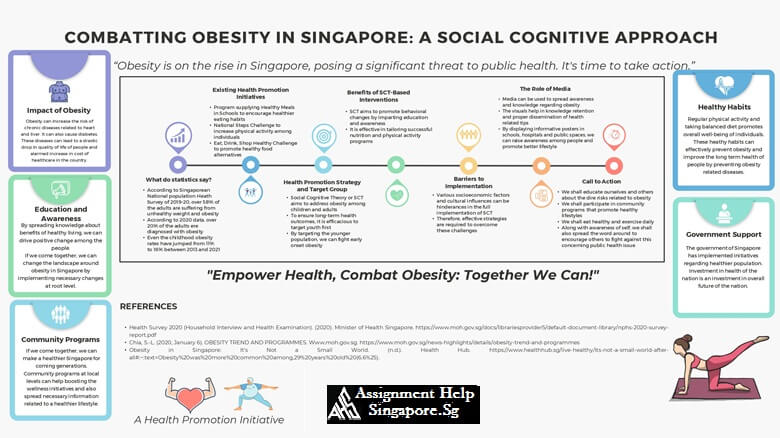
Obesity: A rising public health issue amont Singaporeans
Obesity is a global menace that has gradually engulfed the lives of millions across the world. In Singapore, obesity has emerged as a public health concern and multiple demographics are impacted by obesity in Singapore. The National Population Health Survey of 2019/2020 reveals that there is a crude prevalence of obesity among the residents of Singapore who are eighteen to seventy four years of age (Obesity in Singapore: It’s Not a Small World, n.d.). In 2019-2020 the prevalence rate of obesity in Singapore returned to the previous level of 2010 following a slight alleviation in the prevalence rate in 2013 and 2017. In 2010, the prevalence rate of obesity in Singapore was 10.5% and in 2013 it was 8.6%.
In 2017, the rate of prevalence of obesity again reached 8.6% (Obesity in Singapore: It’s Not a Small World, n.d.). In 2019-2020 obesity again reached the prevalence rate of 10.5%, indicating the gradual rise in the prevalence rate of a menace, which has the potential to decrease the quality of lives of myriads of people. Moreover, the concerned survey found that in 2019-2020, the prevalence rate of obesity among males was 11.9%, which has been more than the percentage levels of prevalence among women (which had been 9.3%) (Obesity in Singapore: It’s Not a Small World, n.d.). The most vulnerable population segment in the context of obesity in Singapore has been people aged 30 to 59 years and the concerned demography’s rate of prevalence of obesity is double than the percentage of prevalence rate among people aged between 18 and 29 (Obesity in Singapore: It’s Not a Small World, n.d.).
But 2021’s findings reported that higher prevalence of obesity has been gradually affecting children and adolescents. In this respect, it has to be taken into account that obesity rates in Singapore among children and adolescents is rising and the rate has risen from 13% in 2017 to 16% in 20201 (Tham, 2023). So it can be seen that a wider segment of the Singaporean population is suffering from the health problem of obesity which have been decreasing the quality of life of those already suffering from obesity.
From the abovementioned discussion, it has become clear that obesity is a rising public health issue in Singapore and effective health promotion strategy is required to address and mitigate the issue. For combating the growing rate of prevalence of obesity, the government of Singapore has already developed and implemented multiple strategic programmes, including the Healthy Meals in Schools Programme and the National Steps Challenge (Healthy Eating for Life, n.d.). And such programmes are aimed at both preventing and reversing the gradually growing prevalence rate of obesity in Singapore.
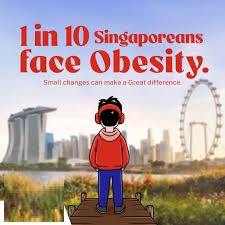
Obesity is a Major Public Issue in Singapore!!
 Decreases Quality of Life
30-59 Years People are Highly Vulnerable
Singapore Government Programes for Obesity
Moreover, health campaigns and programmes are required to address and mitigate the problem of obesity in Singapore, and it is to be noted that several strategies for combating the concerned health problem must include programmes aimed at improving the eating habits of the vulnerable population and increasing the levels of physical activity among the concerned segment of the population. Besides, as a part of a preventive healthcare programme for reducing the rate of obesity across the Singaporean society, the target population (people aged between 30-59 years) should be asked to keep a food diary of what they were eating and where they were eating and what were their feelings before consuming the food (Obesity Prevention, 2023).
The target population should also be instructed to eat “five to nine servings of fruits and vegetables” on a daily basis (Obesity Prevention, 2023). Moreover, the primary objective of the present report is to raise the awareness of the citizenry and residents of Singapore about obesity and to discuss what specific health strategies are in work in terms of addressing and preventing the emergence of obesity among the Singaporeans. Furthermore, the report aims at discussing the relevance and implications of the application of the social cognitive-based health promotion campaigns that have the potential to address and mitigate (as well as prevent) the rise of obesity among myriads of Singaporeans.
Health promotion programmes for obesity in Singapore
As identified earlier, the menace of obesity is gradually rising in Singapore and it is high time that government and advocacy groups head towards developing and implementing healthcare programmes that are aimed at preventing and reversing the problem of obesity faced by a good number of Singaporeans. In this respect, the implementation of social cognitive theory in practice deserves special mention. But before switching to the discussion on the epidemiology of the concerned health problem the discussion on what health promotion programmes for obesity are existing in Singapore, it is to be taken into account that people aged between 30 to 59 years (residing in Singapore) are being impacted by the problem of obesity.
It has been found that among the concerned demography the rate of prevalence of obesity has been 12% – a percentage which is double to the 6.6% of Singaporeans who are aged between 18 and 29 years (Obesity in Singapore: It’s Not a Small World, n.d.). Moreover, it has also been observed that in Singapore, the prevalence rate of obesity among children aged 6 to 18 years is gradually rising and this rise is evident from the increase of the prevalence rate from 13% (in 2017) to 16% (in 2021) (OPEN Singapore, n.d.).
Epidemiology
Obesity is characterized by the abnormal or excessive buildup of body fat, leading to potential adverse effects on health. It is linked to several significant chronic diseases such as cardiovascular disease, Type 2 diabetes, and cancer. The prevalence rate of obesity in Singapore among the Singaporean adults has remained almost constant over the years, but the issue of childhood obesity is gradually surfacing. It is also critical to note that in 2020 around 58% of adults in Singapore lived with an unhealthy weight and among them 20.7% were detected and diagnosed with obesity (Tham et al., 2023). Moreover, it has also been found that in 2020, in Singapore, around 40.6% did suffer from abdominal obesity (Health Survey 2020 (Household Interview and Health Examination), 2020).
Also it has to be taken into account that although the rate of obesity in adults in Singapore stayed consistent between 2010 and 2020, there has been an increase in obesity among school-age youths (6–18 years old). The prevalence rose from 11% in 2013 to 13% in 2017 and continued to escalate to 16% in 2021 (Tham et al., 2023). Moreover, adults are also at risk of developing obesity, and this can be claimed by citing the fact that in Singapore, those adults who are educated up to the primary level has shown the highest prevalence rate of obesity (16.3%), but the proportion has come down to 12.5% among adults who have got secondary education (Tham, 2023).
Also, it has to be noted that adults with post-secondary education (in Singapore) are also affected by obesity and the rate of prevalence has been 8.9% (Tham, 2023). Moreover, from a racial perspective, it has been found that the Malays in Singapore are more prone to obesity. In this respect, it has to be taken into account that 20.7% of Malays in Singapore suffer from obesity, whereas the percentage of obese Indians and Chinese (residing in Singapore) is 14.0% and 5.9% respectively (Lee et al., 2016). It has also been reported that the highest prevalent rate of obesity can be found in people belonging to the age group of 30-30 years, and the percentage of such prevalence rate is 11.5% (Lee et al., 2016).
Existing Health Promotion Initiatives
In Singapore, as discussed earlier, there are numbers of health promotion initiatives undertaken by the government to address obesity. Among such programmes are the programmes initiated by the Health Promotion Board (HPB). For accomplishing the objective of promoting healthy diet (which is a necessary preventive and curative measure for treating obesity), the HPB has introduced certain programmes, like the Healthier Choice Symbol (HCS) and Healthier Dining Programme (HDP) (Chia, 2020). While HDP is meant for increasing the availability of healthier options, the Eat, Drink, Shop Healthy Challenge has been introduced for encouraging healthier purchases (Chia, 2020). All such programmes are dedicated to the cause of curbing the higher prevalence rate of obesity in Singapore and to act as preventive measures for combating obesity.
Get Assistance in Assignments on Obesity!!
Professional Nursing Experts
Native Singaporeans
Plagiarism and AI Free Support
Health Promotion Strategy and Target Group
Considering the fact that childhood and adolescence obesity is gradually rising in Singapore, health promotion strategies should be implemented to safeguard children and adolescents from obesity and hence, they must constitute the health promotion strategy’s target group. Moreover, in the context of addressing the menace of obesity among adolescents in Singapore, the Lifestyle Intervention for Teenagers (LITE) program should be briefly discussed (Chew et al., 2021). The importance of the programme lies in the fact that LITE has shown the feasibility and short-term effectiveness of the program (from the clinical perspectives) and it has also revealed the therapeutic interventions can help obese and overweight children and adolescents to realize that their families are supporting them in the course of overcoming and combating the menace of obesity (Chew et al., 2021).
But as there is no specific programme yet implemented in Singapore to address and mitigate childhood and adolescent obesity, there is a need of developing strategies and programmes like LITE that can systematically address and mitigate the problem of obesity among children and adolescents. In this regard, an approach towards behaviour and social change requires more attention. Hence, it has been deemed important to introduce the social cognitive theory-based health promotion because the theory has the potential to influence behavioural changes among children and adolescents suffering from obesity. Moreover, as at the core of the proposed therapeutic intervention is social cognition, its influence on behavioural change should be briefly discussed.
Besides, in this regard, it has to be understood that obesity is a lifestyle disease triggered by unhealthy behaviours, and hence, the programme should aim at changing the unhealthy behaviours among overweight and obese children and adolescents. And in the aforesaid context the importance of applying social cognitive theory deserves special mention. Moreover, as current evidence speaks for the efficacy of social cognitive theory (SCT) based health promotion interventions, the same would be used to prevent and address as well as mitigate the problems of obesity among children and adolescents (Islam et al., 2023).
As a means of supporting the use of SCT in the healthcare programmes for addressing and mitigating the health problem of obesity, it has to be cited how SCT has proved its efficacy in designing nutrition education and physical activity programmes, specifically meant for the adolescents (Bagherniya et al., 2018). It is commonly known factor that nutritional choices, dieting, physical activities – all are required to address the problem of obesity. And the application of SCT in the process of changing specific eating and sedentary behaviours among children and adolescents can trigger positive health outcomes that could be considered as the signs of combating and overcoming obesity. Moreover, studies have also shown that SCT-based health promotion programmes can reduce and/or prevent overweight and obesity in adolescents, and so its usage and influence should be given priority in terms of addressing and overcoming (as well as preventing) the menace of obesity (Islam et al., 2023).
Barriers to the Health Promotion Strategy
There can be hindrances in the process of implementing SCT as the basis for introducing health promotion initiatives meant for addressing the problem of obesity among children and adolescents. In this regard some social determinants of health need to be discussed. For example, children and adolescents belonging to lower income families in Singapore might find it difficult to adopt the behavioural changes suggested by SCT-based health promotion initiatives for fighting obesity. It is a proven fact that SCT-based health intervention programmes aim at determining how learning occurs in social context with an evolving interaction between person, environment, and behaviour, and as unhealthy eating habits among some children and adolescents can be learned from others in the society, the implementation of SCT-based health promotion programmes should be initiated to address and prevent obesity. But it has to be noted that factors like lower income family background, poverty, and racial stereotypes can affect the eating habits among some children and adolescents, the thorough implementation of SCT-based health promotion interventions can be hindered.
The Media for the Health Promotion Strategy
Posters will be used as means of delivering the objectives of the concerned SCT-based health promotion programme, and there are reasons behind choosing poster as the means. Among such reasons is the fact that poster remains in its designated location for an extended period, facilitating the sustained retention of knowledge and positive attitudes at a level comparable to that immediately following the educational intervention (Hasanica et al., 2020). Hence, the use of poster has been deemed suitable for catering to the healthcare needs of children and adolescents suffering from overweight and obesity. Furthermore, the posters should be put on the walls of education institutions and healthcare centres wherefrom the target audience can learn more about the reasons of obesity, the risks related to obesity, and the ways obesity could be addressed and prevented.
Conclusion and Recommendations to Deal with Obesity Problem in Singapore
The main goal of this report is to increase awareness among the citizens and residents of Singapore regarding obesity. It also aims to examine the health strategies currently in place to address and prevent the occurrence of obesity in the Singaporean population. Additionally, the report seeks to explore the significance and consequences of implementing health promotion campaigns based on social cognitive principles. These campaigns have the potential to effectively tackle and alleviate, as well as prevent, the increasing prevalence of obesity among numerous Singaporeans.
Recommendations on Controlling the Issue of Obesity!!
More future SCT-based health promotion campaigns and initiatives should be funded by the government so that the root causes of obesity can be understood and preventive measures could be taken.
Moreover, it is recommended that more future SCT-based health promotion campaigns and initiatives should be funded by the government so that the root causes of obesity can be understood and preventive measures could be taken. In this respect, it has to be noted that programmes like Healthy Meals in Schools Programme should be replicated to be used in more schools, colleges and universities so that both children and adolescents can learn about the risks of obesity and the ways of preventing overweight and obesity.
To learn more about obesity in Singapore and necessary measures aimed at dealing with such issue, connect with our nursing homework help experts in Singapore for further assistance.


