
SOC252 Religion and Society – Religious Symbols in Everyday Life
Question 1
For this assignment you are asked to adopt a sociologically grounded perspective in observing and reflecting on the use of personal religious symbols in everyday life in Singapore. Such religious symbols may include ornaments (such as amulets), bodily decorations (such as henna or tattoos), and clothing as well as stickers and other religious objects displayed in cars, on house doors, or in shops and restaurants. It could also be other kinds of sensory symbols, such as sounds (e.g. mobile ringtones) or smells (e.g. incense or perfumes). Wherever relevant, do not focus only on differences between followers of the major world religions, but also consider variations within them (e.g. Shaiva/Vaishnava, popular Buddhist/Taoist, Catholic/Protestant differences).
Instructions to Students:
- You are free to narrow down the topic by focusing on specific social contexts or kinds of religious symbols, but you must explain the underlying academic rationale of your choices. While personal familiarity with particular contexts/religions is not a valid academic rationale, an in-depth comparative analysis in respect to a particular issue could be one.
- Relate your discussion to sociological concepts such as the negotiation of identity, performative religiosity, public vs private spheres, secular vs religious spaces (and times).
- Your project may rely on two main sources of data: observation of everyday life (including informal interviews, where appropriate) and at least three academic publications.
- On the basis of your observations and readings, develop a broader sociological argument about the use (and non-use) of personal religious symbols in Singapore.

Want Help Structuring Your Answers!!
 Professional Sociology Experts
All Subjects Covered
Quality Assistance
Experts Answer on Above Question on Sociology
Narrowing the topic and academic rationale
Religious symbol in everyday Singapore
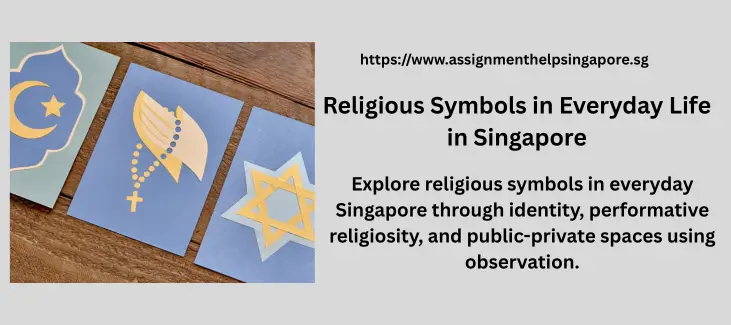
The religious symbols are clearly evident in everyday Singapore through Hindu Vibhuti and Tilak, buddhist amulets and incense, christian crosses, islamic clothing like Hijab and religious objects visible at home and businesses. It clearly indicates that religion is an important part of everyday social life in Singapore’s secular public institutions.
Negotiation of Identity
It is only the religious symbol that allows people to express the cultural and religious identity while complying with Singapore’s multi-cultural environment.
Performative religiosity
By making proper disclosure of religious symbols, it is possible to make the faith socially visible. A Buddhist shopkeeper burning incense or hindu displaying a deity near a business entrance indicates religious identity through an ordinary commercial activity.
Public and private spheres
The religious expression is widely visible in case of private species such as home altars and prayer areas. Public expressions are highly selective because individuals interact with people from different religious backgrounds and operate within Singapore regulated multicultural environments.
Secular and religious spaces
The religious symbols cross the boundary between religious and secular spaces. The religious meaning is evident from a Hindu symbol displayed on a vehicle or a cross worn at work and it shows its implication for commercial, occupational or social purposes.
Differences between religions
It is also important to note that the religious expression is not uniform across religions. For example, Shaiva hindus may give higher priority to Vibhuti and Vaishnavas may use Namam. There is a difference between Catholic and protestant christians in terms of symbols and devotional objects they display.
Broader sociological argument
The evidence from Singapore indicates that religion is negotiated rather than simply confined to formal places of worship. Individuals selectively display, modify or conceal religious symbols as per context, identity and social expectations. Religious symbolism is therefore important in connecting personal faith, group identity and Singapore’s multi cultural public life.
| This model answer is reviewed by Daniel Wong, a psychology and social science expert from NTU. Disclaimer: This answer is a model for study and reference purposes only. Please do not submit it as your own work. |
Want a Full Worked Out Answer with References?
The analysis of religious symbols in Singapore through identity, performative religiosity, public and private spaces and secular religious boundaries above revealed important findings. Get a sociology expert for all your assignment help needs in Singapore or review the solved assignment answers from SUSS before proceeding to order your assignment.

Related answers
 Is Literacy a Defining Characteristic of Religion
- Unintended Effects of Tech & Environmental Change
- Race, Gender & Scams: A Sociological Analysis
- Meritocracy in Singapore Education: Inequality & Policy
- Subculture and Popular Culture Analysis in Singapore
- Durkheim’s Theory and the Social Roots of Depression


