
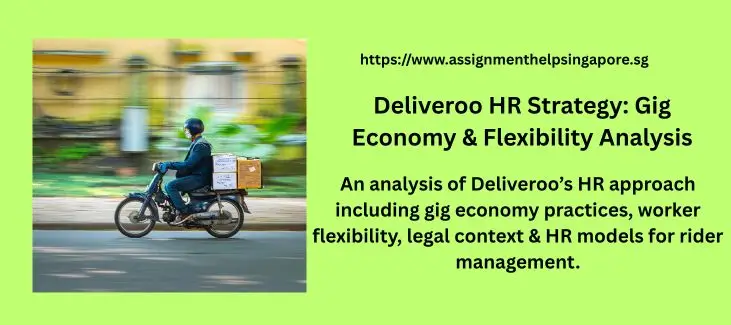
Human Resources Management – Deliveroo HR Strategy
Company Overview
Deliveroo is a UK based start-up company which began as a dream at co-founders Will Shu and Greg Orlowski office desks in 2013. It is a delivery service application (app) that operates with restaurant partners to deliver meals to customers via its riders.
The customer orders food(or other products) via the Deliveroo app, and that is accepted by the restaurant partner. Riders can view incoming order requests by customers in their area, which they can accept or decline, and once accepted the driver is responsible for picking up and subsequently delivering the order, all managed via the app. Deliveroo prides itself on the flexibility it offers to both customers and riders.
The company has faced several issues during its growth period where it has expanded into over 500 cities in 14 countries across the world. Following significant funding from Amazon in 2019 the company (and business model) continues to grow.
HR Trend
Deliveroo is one company which works within the ‘gig economy’ (Kalleberg and Dunn, 2016) in that its riders are not classified as ‘employees’ of the company. Rather, Deliveroo treats its employees as ‘contractors’ meaning that they are essentially self-employed. Deliveroo refers to their riders as ‘independent contractors’ as they are paid by the job.
Healy, Nicholson and Pekarek (2017) suggest that although gig economy working is a minor feature of the labour market, “discussions of the ‘future of work’ – how much work will be available, how it will be arranged and the impacts of technological change – frequently refer to the gig economy” (p.233). O’Connor (2016) discusses the realities of this working pattern within gig economy organisations by exploring the algorithmic management that it utilises to manage employees via the app. Although the use of algorithms to manage workers seems new, it is founded in theory from over a century ago when organisations hoped to manage the tasks and time people took to complete these tasks (known as scientific management).
Many other companies have followed this example,using a system of contracting instead of hiring workers as employees. In addition, many companies in other industries (such as software development, manufacturing and even education) increasingly use contractors rather than employing people on a permanent basis.
Since inception, the company has faced many issues predominantly surrounding workers’ rights for their freelance riders. However, being the first rider and still undertaking deliveries when he can, co-founder and current CEO, Shu, was able to explore challenges the drivers would face and firmly stresses that the most important element for everyone involved is flexibility. Additionally, Shu shares that in his experience the riders will often ‘work’ with several delivery services and will fluctuate between them based on demand (i.e., between Uber Eats, JustEat and Deliveroo), therefore flexibility is key for the riders.
In November 2017, Deliveroo won its UK based legal fight and the right to not call its riders ‘employees’and rather continue to classify them as freelance contractors, unlike rivals Uber. Regardless of this, from 2018 Deliveroo focused on additional perks surrounding riders’ welfare by providing accident cover, first aid training and medical insurance across the world.
Using independent contractors is an attractive option for many employers because they are not entitled to the same rights and benefits as fulltime employees. Key differences between the different types of employees are, for example, they do not need to be paid holiday pay or sick pay, and they do not need to be provided with the tools to do the job (e.g.,a smart phone and bike in the case of Deliveroo, although riders are required to have these). However, this classification of workers has attracted criticism from commentators and politicians throughout the world. Deliveroo stress that the idea of flexibility is core for everyone involved but most importantly for the riders who come from a wide array of backgrounds, with Shu arguing that “…riders do the job because it’s flexible” and believes if the job becomes inflexible then less people will want to do it. This corresponds with positive evidence of the psychological contract from riders who value flexible hours and other perks. However,other ridershave commented on uncertainty, including if a rider has an injury, if their bike is stolen, if the weather is bad, or if there is no demand for deliveries as this can negatively impact riders. These reviews demonstrate the realities of the gig economy on workers.
In Singapore, you are invited to apply to become a driver with ‘a five-minute application’ and informed you only need three things. These include: 1) Singapore citizenship or permanent resident status; 2) A motorbike (with a valid Class 2/2A/2B license) or bicycle, compliant with legal requirements; 3) A reasonably up-to-date smartphone.
Recently, Deliveroo has begun to expand in ‘Deliveroo Editions’ which provide an ‘outpost’ of restaurants where the restaurant partners will provide all resources (e.g., staff as well as ingredients). In Singapore, they are also branching out from just deliveries with ‘food markets’, the largest of which opened Alice@Mediapolis in one-north in March 2019. This large 40-seater ‘futuristic’ dining experience offers a fully automated experience with “no need to interact with human servers at all” (Lim, 2019). You order via a kiosk and collect via a ‘cubbie’ which details the name you have inserted upon ordering. However, this requires staff to be in the kitchen ensuring the food is available and notifying the system when it is ready to collect.
This branching out of services is just oneway Deliveroo is attempting to keep up with its competitors.In 2019 they have also received $575 million investment from Amazon to grow its technical team, develop new technologies, and reach more customers all whilst offering additional support to its restaurant partners and riders. This additional support for riders stems from recognition of the backlash the ‘gig economy’ has received due to the fact companies such as Deliveroo are treating workers as independent contractors rather than employees, which incurs less cost for the company. And after winning their UK legal battle, Deliveroo continues to class riders as contractors, however it has invested in perks for its riders by providing them with cost-free insurance and free access to hundreds of online courses. Also, unlike competitor ‘DoorDash’, Deliveroo have confirmed 100% of tips provided by customers go straight to their riders.
In addition, by utilising this system, employers of independent contractors can more quickly and easily change the size of their workforce in response to changes in demand. This means that using contractors can offer advantages in both cost and flexibility for employers by adapting between numerical, temporal and functional types of flexibility (as Atkinson’s (1984) model suggests as a comprehensive treatment for organisational flexibility). It also means that the overarching business strategy and model hugely affects the people management within the organisation, and in pursuit of the highest level of flexibility there have been loses for many workers; particularly in terms of employment security and added benefits from the company (Healy, Nicolson and Pekarek, 2017). To ensure that Deliveroo can respond to the local regions they will be based within, they opt to introduce Business Intelligence Units to understand and respond to local demands. For example, Klara (2018) commented:“The unit, operating out of Deliveroo Singapore’s corporate office in Tanjong Pagar, will be tasked with the following functions: to deepen understanding of the region – local food trends, tastes and restaurant markets; to enhance performance for riders, restaurants and customers; and to look for expansion opportunities in existing countries and new markets.”
Further, Deliveroo will aim to ensure that they can match the riders to the demand of the area, which will help clarify expectations of both the riders and Deliveroo. This level of local consideration demonstrates Deliveroo’s commitment to adapt and respond their business model to the local context within which they are based.
In researching your answer, you should be using recommended textbooks, journal articles, Deliveroo publications, and articles about Deliveroo and its business practices.
Coursework Assignment Details
Analyse and critique Deliveroo’s approach to HR using two of the following HR topics/models/debates:
- Universalist versus Contingency
- Business Strategy fit with HR
- Atkinson’s flexible firm model
- The psychological contract
- Reward strategies
In your report, you should refer to Deliveroo’s HR practices and additional contextual factors such as the labour market characteristics facing Deliveroo in Singapore, the regulatory environment, the business strategy and growth profile of Deliveroo Singapore, and the HR practices of competitors.
We expect you to evidence the following skills in your report:
- Application of theoretical models and references to understand the reasons behind and potential consequences of HR practices at Deliveroo in Singapore
- Critical analysis of the strengths and weaknesses of Deliveroo’s approach to HR, based on application of models/topics
- Understanding of the inherent tensions in HR (e.g., synchronising with business strategy and promoting good employee relations)

Want Help Structuring Your Answers!!
 Professional HRM Experts
Applies HRM Tools & Framework
Professional Guidance
Expert Answer on Above Deliveroo HRM Case Study
HR approach of Deliveroo
The HR strategy employed by Deliveroo indicates that the company is using a contractor based HR model whereby riders are classified as independent contractors. As a result of this approach, the company achieves higher numerical flexibility in terms of increasing or decreasing Riders, lower level cost, and it allows for faster scaling.
HR topic 1: Atkinson Flexible Firm Model
This particular model is clearly reflected in the HR strategy of Deliveroo as there is clear numerical flexibility identified in the form of making changes to the workforce according to demand, temporal flexibility which allows the riders to work according to their convenience. The financial flexibility is evident in the form of paid per delivery and no fixed salary by the company. The advantage of this particular strategy is that it allows for matching unpredictable demand, reduced labour cost and also allows for international expansion easily, but the weakness is job insecurity for Riders, and is highly opposed by the Labour Union citing lack of employment rights.
HR topic 2: The psychological contract
The promises that are implied from Deliveroo’s strategy to riders are flexibility and independence, freedom to work across multiple platforms and extra benefits in terms of insurance and training. The contract is quite effective for Riders that value working on their own hours and earn extra income, while it is not effective for Riders because of income uncertainty and there is no additional pay allowed except basic insurance in case of illness.
Business strategy fits with HR
The business strategy of the company is to achieve growth, innovation in technology, and be highly responsive towards the market condition. The HR model of the company is quite effectively supporting its business strategy in the form of allowing the company to enter into new markets easily, keeping its cost of operations low, and performance is controlled using algorithmic management. However businesses mainly look for flexibility while workers want security and this is where this particular strategy is quite problematic.
Singapore context
The HR strategy followed by Deliveroo is largely based on local conditions whereby there is strong demand for part time platform work and the regulatory environment is also quite favourable for this contractor model.
Strengths of Deliveroo’s HR Approach
The common strength point includes cost efficiency, allowing business to perform faster growth, attractive to workers that value flexibility.
Weaknesses of Deliveroo’s HR Approach
The major weaknesses include worker insecurity, legal risk, low commitment from employees, and public and political criticism.
| This model answer is reviewed by Kelly Tan, experienced in labour law matters, policy development and conflict resolution. Disclaimer: This answer is a model for study and reference purposes only. Please do not submit it as your own work. |
Want a Full Worked Out Answer with References?
Solving complex HR case studies needs practical understanding of HR concepts and theories. The application of Atkinson’s flexible firm model needs good understanding of the process which can be sometimes challenging for students to accomplish. Getting support from professionals is a good approach, as our HRM case study writing experts are good at providing guidance on practical approaches to follow while solving case studies.

Check Samples on HRM Assignment Written by Experts
Related answers
 Critical Perspectives in Management & Organisation Assignment
- Employee Engagement & Talent Management Analysis | VitaCare
- Interview Plan & Assessment Form | HR Recruitment
- HRM Assessment: Recruitment, HEXACO & Selection Methods
- BARS Performance Management Report for Singapore Jobs
- Workforce Planning – Flexible Work Arrangements
- People Analytics & AI Workforce Report – GastroPOP
- HR Wellbeing Interview Questions – Tekki-Research Pte Ltd
- Leadership & Team Development in Banking Industry
- Singapore FWA Guidelines: Workforce Challenges & Solutions


