
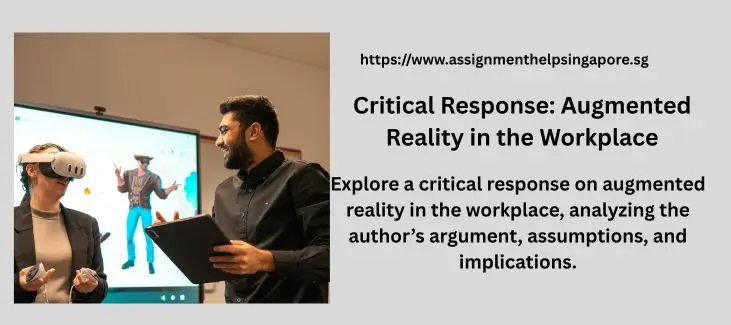
Critical Response: Augmented Reality in the Workplace
- Read the article entitled, “The Rise Of Augmented Reality In The Modern Workplace”: the-rise-of-augmented-reality-in-the-modern-workplace
- Understand the key argument and supporting details.
- Then use other sources to respond to any key point in the article,
i. take a clear position on a key point in the writer’s article and
ii. write a cogent and critical response. - Remember, ‘critical’ in ‘critical reader response’ does not mean to criticise, oppose or demolish the writer’s argument. Instead, it means showing a clear and in-depth understanding of the author’s
i. purpose,
ii. question at hand,
iii. information,
iv. interpretation & inference,
v. concepts (if any),
vi. assumptions,
vii. implications & suggested consequences and
viii. point of view or position and then commenting with evidence from other reliable sources. - This means that you should equally comment on the author’s / article’s strengths as well as weaknesses.
- Therefore, there is no “right” or “wrong” answer. Instead, your reader response will be assessed on your ability to demonstrate an understanding of the source article by stating your position on an aspect of the article and supporting your position with substantial evidence from other reliable sources which you must cite clearly and accurately both within and at the end of the text using APA 7th edition referencing convention.

Want Help Structuring Your Answers!!
 Business Management Experts
All Subjects Covered
Professional Guidance
Expert Answers on Above Questions on Business Management
Introduction
Augmented reality will have a significant influence on the ways in which workplace functions. It will offer benefits in terms of training, collaboration, safety and remote support. According to the article, on-the-job learning would be highly efficient because of AR technology and thereby allows for virtual collaboration between remote teams and provide guidance to the workers with complex tasks.
Key argument
The main argument in the given article is to allow the readers to understand the practical potential of augmented reality in the modern work environment. The article analyses the ways in which augmented reality adds value to workplace processes and thereby helps in improving productivity while reducing error and cost.
Key point analysis – AR impact on productivity
The analysis of the article indicates that augmented reality helps in improving workplace productivity in terms of accelerating the training process and operational tasks. I completely agree with this point.
Supporting evidence and critical analysis
In terms of supporting evidence, it is identified that augmented reality can help in revolutionizing the training by way of overlaying digital instructions leading to faster learning and better skill retention. Other research indicates that augmented reality is quite useful in reducing mental workload and helps in enhancing the task performance. It also helps in simplifying the complex tasks and also assists with personalised training to individual learning styles.
Weaknesses
In terms of weaknesses, augmented reality has long term drawbacks, as it helps in improving the short term task efficiency that can reduce employees ability to internalise skills and think critically. It implies that the organisations should make use of AR for their routine tasks with strategies that encourage employee agency and creativity to sustain long term performance.
Additional strength
Another major strength of augmented reality is its ability to bridge geographical gaps, and thereby enabling remote collaboration and shared views of 3D models or data. Augmented reality is useful in allowing remote interaction and thereby reducing any chances of miscommunication specially in case of distributed teams.
Additional weakness
There are significant technical, cultural and cost barriers associated with utilising augmented reality that directly affects the implementation process. For example, the major barriers include infrastructure limitations, high initial cost and resistance from workers.
Conclusion
Then analysis of the article provides a compelling view of how Augmented reality can help businesses achieve significant improvements in the performance. The benefits in terms of training efficiency, collaboration, safety and remote support are significant but the long term effects need to be considered such as the ability of employees to innovate and think critically in the long run.
| This model answer is reviewed by Pamela Lim, having good understanding of business management practices. Disclaimer: This answer is a model for study and reference purposes only. Please do not submit it as your own work. |
Want a Full Worked Out Answer with References?
Topics based on augmented reality, digital transformation or emerging workplace technologies require critical analysis of innovation strategies in evaluating the impact of technology on productivity and leadership. This can be sometimes challenging for students and if you are faced with difficulties in your augmented reality task, consider our business management assignment help experts to assist you with turning the complex ideas into well structured evidence based academic work.

Check Business Management Samples Written by Experts
Related answers
 Charles & Keith Brand Development Strategy Analysis
- Computational Thinking & Power Automate Assignment
- Types of Meetings in MICE Industry Explained
- QAF Gardenia Bread Analysis & Business Excellence Insights
- LaunchPad Studio Business Model Canvas & Financial Plan
- Business Modelling: Finance & Sales Compensation
- Service Operations Management Evaluation – Singapore
- Innovation in Foldable and Stretchable Phone Displays
- Business Feasibility Report: Travel With Host (TWH) Platform
- Workplace Wellbeing, PERMA Model & Leadership Styles


