
Strategic Management in a Global Context
Case Study on A Strategic Position and Options Analysis of an Organisation in the Petrochemicals Industry in Singapore.
Singapore, as the city of green possibilities, has the green plan initiatives for a greener Singapore. The green plan calls for all stakeholders’ engagement and green citizenry to tackle climate change for a resilient future.
Introduction
In this assessment, you will identify a key player in the petrochemicals industry headquartered in any country/region of your choice but operating in Singapore ( such as Trafigura, ExxonMobile, Shell, and Lanxess). After selecting a company of your choice, you will determine the strategic position of the company and make strategic recommendations with a focus on how to implement a sustainable strategy to decarbonise its activities (This is the strategic issue).
Background
Singapore ranks as the fourth most sustainable city in Asia, according to the 2022 Sustainable Cities Index. Yet, industrial pollution is still a major challenge for the country. In 2019, the parliament reported that about 75% of industrial emissions are from refining and petrochemicals sector. The situation is not improving despite significant effort of the major players in the petrochemicals industry.
You can browse through some of the links for a better understanding of green plan initiatives and the petrochemicals industry in Singapore. You are encouraged to undertake further research to back your understanding.
Scenario
Following the successful completion of your degree course, you have secured a strategy consultant job in a top-tier consultancy firm. You are attending the first meeting with your team. Your line manager asks you to introduce yourself to colleagues and share your passion for strategy and sustainability. You explain brilliantly how future business winners need to implement today sustainable strategies for tomorrow.
Task
Enthused by what you passionately conveyed about sustainable strategy; your line manager is keen to test your strategic planning skills. Your manager asks you to select an organisation of your choice in the petrochemicals industry in Singapore. The company can a global or local player operating in Singapore.
Your task is:
- to produce a strategic position analysis for the company of your choice, and
- to make recommendations to adapt the company’s strategies for a sustainable future.
Given that the essay is going to be shared with the senior management team, the line manager suggests the following structure for your essay.
Title Introduction
Strategic Position Analysis
- External Analysis: Macroenvironment and Industry Analysis
- Internal Analysis: Analysis of resources and capabilities
SWOT resulting from the analysis (presented in a table format) External (Opportunities and Threats)
Internal (Strengths and Weaknesses)
TOWS Matrix and Strategic Options
Recommendations for sustainable strategy (using SAFe – make your own justifications)
Conclusion Reference list Appendix
The title page, reference lists, tables and appendix are not included in the word count.
You are expected to research relevant information about the sector and the company of your choice. The company can be a global player operating in Singapore or a local petrochemical company as well. You are expected to use frameworks and models stemming from the lecture, textbook and academic sources covered in the module. You should use diagrams and tables as much as possible to illustrate your core ideas. Tables and diagrams are not included in the word count. Chapters 3 (Macro-Environment Analysis), 4 (Industry and Sector Analysis) and 5. (Resources and Capabilities Analysis) from Exploring Strategy: Text and Cases might be useful to perform the strategic position analysis, as well as content from the module content.
The total word count of your answers to both questions must be 2,250 words and it must comply with the guidelines provided here:
- Introduction and background section: 250 words
- Strategic position analysis: 1400 words
- SWOT and TOWS Matrix: presented in a table (excluded in the wordcount)
- Recommendation (choosing the best strategy mix): 350 words
- Conclusion: 250 words
The word limit for the coursework does not include the cover page, reference list and tables or diagrams. This is subject to a ±10% allowance to the allocated word count. Where a submission exceeds the stated word limit (allowing for the +10%), the maximum grade awarded will be P1. Appendices can be useful to provide additional information from your analysis, but you must incorporate the key analytical arguments into the main body of your answer.
Additional Guidance
The introduction should set the scene and explain the need to perform this strategic position analysis. Relevant figures and data should be used to reinforce the background. The introduction should present an overview of the essay.
Part 1
Firstly, this section focuses on the external part of the strategic analysis. All elements from the external environment influencing the organisation’s strategy should be considered and segmented into opportunities and threats. You are advised to support your analysis using relevant frameworks and evidence stemming from your own research.
Secondly, this section focuses on the internal part of the strategic analysis. All elements associated with the internal focus of the organisation should be considered and segmented into strengths and weaknesses. You are advised to support your analysis using relevant frameworks and evidence stemming from your own research.
This section above should culminate into the SWOT/TOWS analysis
Part 2 Recommendations and Conclusion
The recommendations should be Specific Measurable Achievable Relevant and Time- bound (SMART). These recommendations should be aligned to TOWS strategic options (Make your own judgment with reasoning to prioritize options)
The conclusion should recommend a clear strategy for a sustainable future for this organisation in the petrochemicals industry.

Want Help Structuring Your Answers
 Professional Strategy Experts
Applies Models & Framework
Professional Guidance
Experts Answer on Above Questions on Strategic Analysis
Company selected for analysis
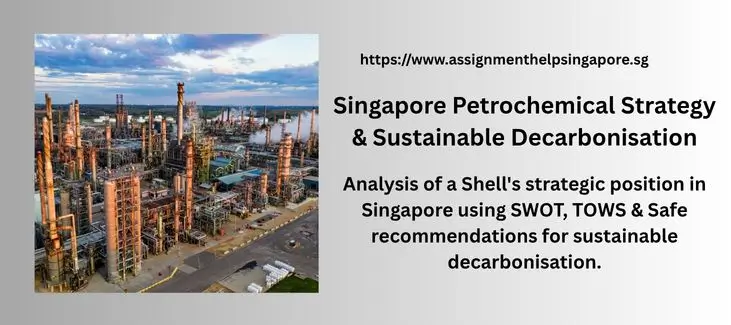
The company selected for analysis is Shell which focuses on its Singapore operations and Jurong Island petrochemical activities.
Strategic position analysis
External analysis – PESTEL
The application of PESTEL strategic tools indicates that the political environment in the form of Singapore’s Green Plan 2030 and decarbonization policies increases pressure on energy intensive industries to reduce emissions. It has a significant impact on Shell and requires the company to align its Singapore operations with the national transition objectives. From an economic point of view, the low cost producers along with changing demand for fossil fuel derived products create extra pressure on the margins of the company. From a social aspect, the investors and community increasingly expects organisations like Shell to demonstrate measurable environmental responsibility. The technological footprint indicates the application of electrification and renewable energy sources can reduce the carbon intensity of petrochemical operations. While the legal aspects indicate tightening environmental requirements in terms of the carbon pricing framework in Singapore which will further increase the cost of maintaining carbon intensive operations.
Industry analysis – Porter Five Forces
The analysis of the industry implies a high competitive rivalry as Shell competes with Global energy and petrochemical companies operating in Singapore. The supplier power is moderate because the specialised technology providers can significantly influence the cost, while the buyer power is moderate to high because large industrial customers can compare suppliers internationally, and accordingly make decisions for lower-carbon products. The threat of substitutes is increasing as there are alternative fuels like bio based materials, recycled materials and solar power sources. The threat of new entrants is low to moderate because the capital requirements and regulatory requirements create significant entry barriers.
Internal analysis – resources and capabilities
The physical resources available to Shell is a huge industrial infrastructure and established presence in Singapore. Along with this, the financial resources includes a significant global scale provider having great capacity compared to smaller competitors and this support financing of large scale transition projects. With respect to technology, the company possesses substantial technical expertise across energy, chemical and industrial operations. Not only this, the company has human resources capabilities in terms of specialist engineering, operational and research experts good at Re designing energy intensive production processes. However the major weakness is the path dependency as an established petrochemical infrastructure creates such a dependency.
SWOT analysis
The strengths of Shell include established Singapore operations, global financial resources, strong technical expertise and large scale infrastructure, while the weaknesses are exposure to carbon intensive petrochemical activities, high transition investment requirements, reputational criticism and dependence on fossil based feedstocks. With respect to opportunities, it can explore industrial partnership, adapt circular economy solutions, and low carbon chemicals and carbon capture and storage. The threats are rising carbon costs, stricter carbon regulation, strong regional competition, and changing customer preferences.
TOWS strategic options
With respect to SO, the option available to Shell is to utilise financial and technological capabilities to develop low carbon petrochemical products. For ST strategy, the option available is to utilise existing industrial scale and technical expertise in order to reduce exposure to carbon pricing. For WO, the company can utilise partnership and new technologies in order to overcome the carbon intensity of existing infrastructure. For WT, the company can reduce its dependence on high carbon activities and avoid excessive investment in assets that would become commercially unattractive under tight climate policies.
Recommendations Using SAFe
It is recommended to accelerate low carbon industrial infrastructure, develop a low carbon petrochemical portfolio, and build strategic partnerships in order to significant growth in its Singapore operations.
| This model answer is reviewed by Lim Sher Tynn, a strategic management expert offering critical strategic analysis using appropriate tools and frameworks. Disclaimer: This answer is a model for study and reference purposes only. Please do not submit it as your own work. |
Want a Full Worked Out Answer with References?
The strategic analysis as carried out above reflected important findings about Shell’s strategic position in Singapore. With our strategic management experts, you can also get a similar kind of analysis for your specific Singaporean company, by utilising appropriate strategic tools and frameworks. Simply visit our assignment help page in Singapore to get a professional assignment writing expert for your strategy or any subject assignment. You can also access our expert solved answers for assignments from Edinburgh Napier University across different subjects to improve your confidence level before proceeding to order the assignment.

Check Samples on Strategy Written by Experts
Related answers
 Gymshark Social Selling & E-commerce Strategy Report
- SBIZ LinkedIn Content Audit & Strategy Report
- Oral-B Market Analysis – SWOT, PESTEL & Porter Five Forces
- Monti Singapore F&B Analysis: HACCP, PESTLE & Strategy
- Zenith Tower FM Strategies: ESG & Smart Tech Solutions
- Strategic Analysis Assignment – PESTEL & Five Forces Guide
- Singapore Trade Competitiveness & Crisis Recovery
- Strategy & Leadership – Hierarchy of Choices & I-ACT
- Global Expansion Strategy Report – CAGE, PND & AAA Analysis
- Disruption in the Financial Service Industry Singapore


