
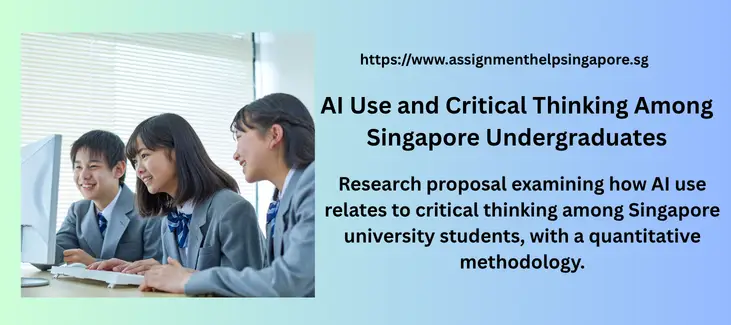
PSY391 Applied Research Methods and Statistics – AI Use Among Singaporeans
“Mr Lee said that while AI is an incredible tool, it must not become a shortcut. He used the legal profession to illustrate the difference between machine execution and human expertise.
“These tools allow lawyers to generate submissions for a case… but the senior lawyer, having gone through the rigmarole and the rigour of legal training and legal practice, will look at the submission and say, ‘Will this fly in front of the judge, and will it fly in front of this judge, given his or her temperament?’
“If you say, ‘Well, if that can be done by an AI tool, then I don’t even need to go for the rigour of legal training’, I think that will be a big mistake,” he added.”
Source: Chan, G. (2026, April 1). Higher education must sharpen human judgment, problem framing: Panellists at ST Education Forum. The Straits Times. https://www.straitstimes.com/singapore/parenting-education/higher-education-mustsharpen-human-judgment-problem-framing-panellists-at-st-education-forum
While beneficial, the rise of artificial intelligence (AI) use in classrooms has introduced new issues regarding its use and impact on students’ academic integrity, learning quality and critical thinking skills. One key issue is cognitive offloading, referring to students’ reliance on AI tools to do the thinking for them, which undermines independent thinking. There is thus growing impetus to address how students can use AI effectively while retaining their fundamental human judgement. Assume you are a research consultant engaged by the Ministry of Education to investigate how university students use AI tools in Singapore. The findings will inform policy and the development of educational interventions in local universities. Apply your knowledge in research methods and statistics to evaluate existing research and statistics to prepare a research proposal that aims to investigate factors relating to AI use among undergraduates by focusing on one topic of interest below:
- Psychosocial factors of AI reliance
- AI use and critical thinking
- Predictors of responsible AI use
Findings from the proposed research will inform policy and programme development for Ministry of Education and the local universities. Depending on your chosen topic, you should examine which research methodology would be most appropriate (i.e., quantitative or qualitative in nature). You should not do a mixed-method design. You are not required to run any data analysis but should interpret the results assuming they support your hypothesis(es) or research question(s). Your proposal should be reported in APA formatting. Your research proposal should include the following sections and should not exceed 2,500 words in total (excluding references and appendices):
- Introduction and literature review
- Research question(s) and/or hypothesis(es)
- Methodology
- Proposed data analysis
- Discussion
- References

Want Help Structuring Your Answers!!
 Professional Artificial Intelligence Experts
Applies Models & Framework
Professional Guidance
Experts Answer on Above Questions on the Use of AI Among Singaporean Students
Introduction and literature review
The use of AI is significantly higher among students worldwide, and with respect to Singapore, the situation is not different, as a student survey in 2026 in Singapore reported that 93% of the students had used AI, and there are more than half of the students that have expressed concerns about its impact on the critical thinking ability of students. There are around 382 students surveyed in a 2025 NUS study on GenAI frequency uses and high order thinking, and the evidence shows mixed findings. A study of 580 University students indicates that the greater use of AI and dependence on it is directly associated with lower critical thinking. The given study therefore emphasizes on analysing whether frequency and dependency on AI for academic tasks are associated with undergraduate critical thinking ability in Singapore.
Research question and hypothesis
The main research question is ” what is the relationship between AI use and critical thinking ability among Singapore undergraduate students? In relation to this, the hypotheses considered are
H1: The higher frequency of AI in academic tasks directly lowers the critical thinking ability of students.
H2: Increasing dependence on AI is directly related to lower critical thinking scores.
H3: Students that perform critical analysis of AI generated information have higher critical thinking scores compared to students who accept AI without verification.
Methodology
The methodology that is appropriate for the given quantitative study is a cross-sectional survey because the study aims at measuring the relationship between AI use behaviour and critical thinking ability among undergraduate samples.
A sample size of 400 undergraduate students from Singapore universities will be selected, and the independent variables are the AI use frequency, AI dependence and AI verification behaviour, while the dependent variables are critical thinking scores. The control variables in the study are age, year of study, academic discipline and prior AI experience. This stratified sampling strategy will be utilised where feasible to improve representation.
Proposed data analysis
The collected data will be analysed using descriptive statistics such as a use frequency and average critical thinking scores, and the specific statistical techniques that will be utilised are Pearson correlation to analyse the relationship between AI use, dependance and critical thinking, multiple regression analysis to determine whether AI frequency and dependance predict critical thinking scores. The statistical significance at p <.05 will be utilised.
Discussion
If the finding positively supports the hypothesis, it would imply that a frequent or dependent AI use may be associated with weaker independent critical thinking. With respect to Singapore universities, the policy implication would not be to prohibit Ai, rather than interventions aimed at emphasizing AI verification, independent reasoning and evidence evaluation.
| Disclaimer: This answer is a model for study and reference purposes only. Please do not submit it as your own work. |
Want a Full Worked Out Answer with References?
The proposed research proposal on evaluating the AI use and its implication on critical thinking among Singapore University students above indicates important aspects that will be covered in finalising the proposal. With our research proposal writing service in Singapore, you can also expect to get similar kind of support with your research proposal. To make yourself confident, you can review the solved assignment answers from SUSS by our experts.

Related answers
 AI & Smart Pest Management in Facility Management Assignment
- Sustainability Proposal & Strategy Report Analysis
- Bullying in Singapore Schools: Research Proposal Development
- Word Embeddings Evaluation & AI Ethics Chatbot
- E-Commerce Brand Loyalty Research Proposal Singapore
- Generative AI in Asia: Impact, Challenges & Strategy
- Fundraising Proposal for Unlocking ADHD Support Hub
- Factors Affecting Polytechnic Student Well-Being


