
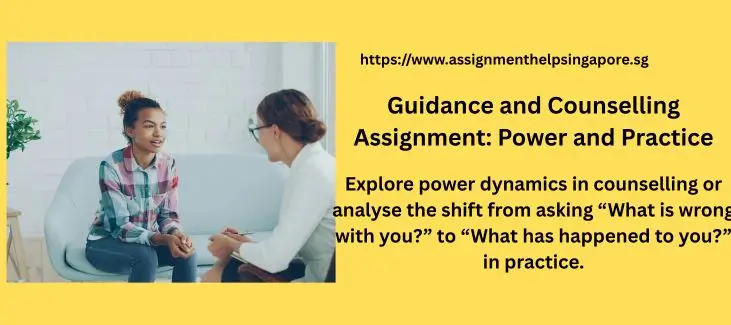
PP0549 The Skilled Helper – Guidance and Counselling Assignment
Assignment Questions
Choose ONE of the following titles:
- Why is power an important issue to think about in guidance and counselling practice?
- Critically reflect on the differences of approach underlying the questions ‘What is wrong with you?’ and ‘What has happened to you?’
Alternatively, you may wish to present your assignment in two parts, with 1500 words addressing one of the above titles and 1500 words of autoethnography. This is to say. you may choose to present your autoethnography as a formative piece of work or as part of your assessed work. If you include it as part of your assessed work, usual marking standards will apply.If you choose to do this, you are required to submit essay and autoethnography as a single document (i.e., as Parts A and B of your assignment) the usual way through Blackboard.
Please note: You need to demonstrate:
- A clear understanding of the appropriate theoretical / knowledge base necessary for addressing the question
- A clear evaluation of its implications for practice.
- The ability to collate and assimilate information effectively.
- The ability to demonstrate background research into your topic, through references and appropriate bibliography.

Want Help Structuring Your Answers
 Singaporean Psychology Experts
All Subjects Covered
Professional Guidance
Experts Answer on Above Questions on Counselling Psychology
Why is power an important issue in guidance and counselling practice
The role and implication of power in case of guidance and counselling practice is mainly because of the professional knowledge, ethical responsibilities and influence our clients have. It is the good understanding about power that makes sure that counselling is highly respected, ethically accepted and focussed on client needs.
Theoretical understanding
Since a counselor is considered as an expert, the power is automatically available in the counselling relationship. It is important for the counsellors to minimise power imbalances as power differences can result in direct impact on the therapeutic relationships.
Implications for practice
It is important for counsellors to support client autonomy, confidentiality and maintain professional boundaries. This will also avoid imposing any kind of personal values and make the client feel empowered rather than controlled.
Difference between what is wrong with you and what has happened to you
Both these questions indicate different approaches to understanding the difficulties faced by a person. The first one emphasizes the problems and symptoms while the other one focuses on experiences and life events.
What is wrong with you is closely associated with a medical model which aims at identifying any kind of disorders or deficit. It is quite effective in diagnosing help conditions, and also adequately supports treatment planning, while it may stigmatize individuals, and make them focus on weaknesses rather than the strengths. What has happened to you is associated with trauma informed practices, and it recognises that behaviour may result from past experiences. The strength of this approach is its support towards empathy and understanding, and promotes client empowerment and resilience while it may not be effective in fully addressing health disorders and requires a careful exploration of experiences.
| The model answer above is reviewed by Daniel Wong, a psychology expert, specialises in critical analysis and argument development in psychology. Disclaimer: This answer is a model for study and reference purposes only. Please do not submit it as your own work. |
Want a Full Worked Out Answer with References?
The analysis indicates the role of power in counselling relationships, ethical practice, decision making and client empowerment. If you need assistance with a similar kind of analysis on evaluating the role of power, get in touch with our professional assignment helpers in Singapore for best writing support with psychology assignment.

Related answers
 Youth Case Study: Risk, Ecological & Ethical Analysis
- Eating Styles & Personality Genetics Study Report Answers
- Social Psychology Media Analysis: Bias & Representation
- Ceiling Height & Nonverbal Behavior Study Poster
- Performance Psychology Workshop Assignment Help
- Fitspiration Study: Effects of Instagram Images on Body Image
- Decision-Making Case Study: Jason’s Career Risk Analysis
- Trauma and Attachment Case Study: Amy and Jay
- Psychological First Aid Role-Play & Training Case Study
- Cyberbullying and PTSD: DSM-V Diagnostic Evaluation


