6KNIS605 Summative Assessment Essay Writing
- Assessment Title: – “Critically analyse and evaluate the assessment and management of an older adult with complex health and social care needs.”
- Case Selection: You may use a case scenario from your own clinical practice, or if this is not possible, select one of the case scenarios provided by the teaching team on KEATS.
- You can also choose to focus on one core aspect of care (dementia, frailty) or/and use the CGA framework or WHO framework.
Summative Guidelines – Summative Assessment
- A 2000-word case study, which will have 100% weighting.
- The case study will allow you to demonstrate the application of a recommended tool for assessing and managing an older person’s care with complex health and social care needs.
Summative Assessment – Essay Plan Example
Introduction (200 words approx.)
- Briefly introduce the case study (confidentiality maintained)
- Identify key physical, psychological, and social issues
- Define complexity and link to case study (e.g. multimorbidity, frailty, social vulnerability)
Holistic Assessment (700 words approx.)
- Discuss and apply relevant assessment frameworks and tools and discuss any relevant theories. For example: CGA framework /ICOPE and one assessment tools. Keep to a minimum of two assessment tools. Critically discuss their effectiveness and limitations.
- Demonstrate a holistic understanding of the assessment of the older adult (case study) with complex health and social care needs, including physical, psychological, and social dimensions.
Management Interventions (700 words approx.)
- Demonstrate a holistic understanding of the management of the older adult with complex health and social care needs, including physical, psychological, and social dimensions.
- Consider the importance of individual preferences and the role of family/care givers.
- Consider any local or strategic interventions and their advantages and/or disadvantages.
Ethical, Legal or cost/resource considerations (200 words approx.)
Conclusion (200 words approx.)
Scenario
Scenario 1: Mr. Raymond Tan
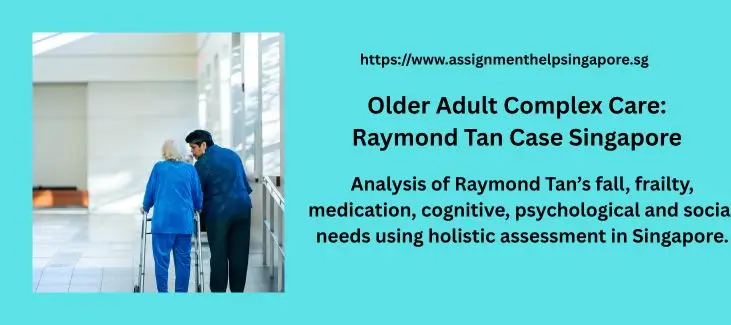
Mr. Raymond Tan is a 79-year-old retired school principal who was admitted to the emergency department at the National University Hospital in Singapore after a fall in his
home bathroom. He sustained a minor head injury and extensive bruising but no fractures. His daughter, who lives in Sengkang, brought him to hospital after he was
found on the floor when he did not answer her usual morning call. Raymond lives alone in a three-room House and Development Board (HDB) flat in
Queenstown. He has managed independently since his wife passed away three years ago, but his daughter has noticed he has become increasingly forgetful. He uses a
walking stick for ambulation but reports feeling dizzy when rising from bed. His medication list includes:
Amlodipine – 5 mg OM
Furosemide – 40 mg BD
Spironolactone – 12.5 mg OD
Metformin – 500 mg BD
Lorazepam – 0.5 mg ON
He admits he sometimes takes his medication “when he remembers.” On assessment, his blood pressure is 82/54 mmHg. There are no grab rails in the bathroom, and his
apartment is cluttered. His daughter is concerned about his ability to continue living independently, especially after this incident. He refuses to consider a nursing home, stating he does not want to
“lose his freedom.” He expresses anxiety about falling again and reports sleeping poorly since the fall

Want Help Structuring Your Answers
 Professional Nursing Experts
All Subjects Covered
Professional Guidance
Experts Answer on Above Questions on Nursing Case Study
Introduction – Case analysis of Raymond Tan
The analysis of the case scenario of Raymond Tan indicates that he is a 79 year old man living alone and developed multiple conditions for complex care. The issues noted are fall, severe hypotension, dizziness, cognitive decline, anxiety and unsafe environment at home which necessitates the need for complex care.
Holistic assessment
Assessment tool 1 – comprehensive geriatric assessment
The assessment of Raymond should be carried out across four important areas including his physical condition followed by a fall, injury, cardiovascular conditions and mobility. He should also be examined for functional assessment as he utilizes a walking stick, able to bathe safely and manage daily activities independently. The psychological assessment should focus on areas including poor sleep and cognitive decline while the social aspect also needs to be considered as his living alone, and has strong reference to remain at home.
Assessment tool 2 – Falls/frailty assessment
There are many fall-risk factors noted in respect to Raymond including previous fall, dizziness when standing, BP of 82/54 mmHg, walking stick depends, unsafe cluttered home and cognitive impairment. A fall assessment would be useful in determining his functional vulnerability and any modifiable risk.
Cognitive assessment
Cognitive assessment is also necessary because of his developing condition of forgetfulness and inconsistent medication use.
Medication assessment
The medication assessment is also important because of his reported concern about medication related hypotension.
Management intervention
Management interventions are essential for physical improvement, home safety, cognitive and social improvement. The interventions for physical improvement require performing medication review, providing physiotherapy strength, reviewing his walking aid requirements and implementing a fall prevention plan. With respect to home safety, it is assessed that Raymond’s bathroom presents significant environmental risk which needs interventions in the form of installing bathroom grab rails, improving bathroom safety by removing clutter and trip hazards, and also consider an occupational therapy home assessment. The psychological interventions will focus on educating Raymond about fall prevention, psychological support using sleep assessment and non drug sleep strategies. The cognitive interventions require proper investigation for his forgetfulness and should not be simply assumed as dementia. Finally in respect to social aspects, it is important to look for the availability of community support to deal with the issue of social isolation.
Singapore specific management
Considering the Singapore specific management, the support to Raymond can include primary care/ community care follow up, allied health assessment and community support services rather than considering him moving to residential care. The main focus should be on keeping Raymond safely at home while reducing the risk of another fall.
Ethical, legal and resource issues
Raymonds should be provided with complete autonomy and should not be forced for a Nursing Home if he refuses it. As he is experiencing the problem of forgetfulness, it is important to do proper assessment of his ability to understand and manage important healthcare decisions where concerns arise. With respect to confidentiality, his daughter should be provided with relevant information after taking proper consent from Raymond.
Conclusion
Raymond fall is not to be considered as an isolated problem, as other areas like hypotension, dizziness, medication issues, anxiety, who is sleep and mobility limitations also need to be considered, as they increase the risk of further deterioration. Management should focus on fall prevention, medication optimisation and community support while respecting Raymond’s wish to remain independent.
| This model answer is reviewed by Amanda Wun, Nursing Graduate from Ngee Ann Polytechnic a nursing expert excellent in analysing nursing case studies. Disclaimer: The response above to the case study is provided for academic study purposes and is not intended to offer any kind of medical advice, diagnosis or treatment guidance. This answer is a model for study and reference purposes only. Please do not submit it as your own work. |
Want a Full Worked Out Answer with References?
Solving complex nursing case studies needs professional expertise and sound understanding of nursing terminologies and concepts. With our nursing homework helpers in Singapore, you can expect to get solutions for complex case studies similar to Raymond’s case. Simply visit our assignment help Singapore homepage to get a professional expert for your assignment. You can also explore the solved assignment answers from Kings College to know more about our expert’s ability to write assignment.

Check Samples of Nursing Assignment Written by Experts
Related answers
 Postnatal Depression: Signs, Risk Factors & Support
- MediSave Withdrawal Limits for Outpatient Treatment
- Madam Sumi Active Ageing Case Study: Health & Fall Prevention
- Gen AI in Healthcare Decision Making Policy Brief Singapore
- Nutrition Care Process SOAP Case Study: Diabetes Patient
- Pharmacy Management and Cardiovascular Risk Assessment
- Madam Aishah Case Analysis on Chronic Disease Management
- Singapore Social Work & Healthcare Case Study Analysis
- Health Promotion Strategy in Singapore: Targeted Approach
- Biomedical Device Startup Mission, Needs & Concept Design


