
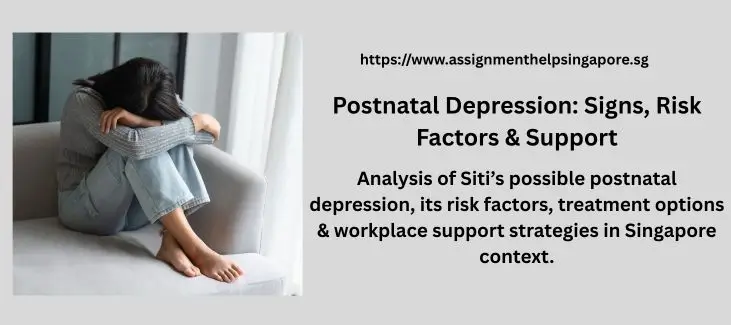
PSY213 Mental Health & Well Being in Singapore – Postnatal Depression Analysis
Siti, a 26-year-old administrative staff member, has recently shown noticeable changes in her behaviour at work. Over the past month, she has been arriving late frequently, and she appears visibly fatigued, rubbing her eyes, yawning, and struggling to concentrate during meetings. Although she continues to complete her assignments, her work quality has declined and no longer reflects her usual standards. Siti becomes tearful at times, but she tries to hide it and quickly composes herself if anyone approaches. Once known for her friendly nature and easy small talk, she has become increasingly withdrawn. Siti no longer joins the team for casual conversations. She often avoids eye contact and prefers to spend her lunch breaks alone. You are aware that she is a new mother who has recently returned to work after her maternity leave. She frequently checks her phone and makes multiple calls home to check on the baby after which she sometimes looks worried or distracted. These changes have begun to affect team dynamics, and you start to feel concerned about her well-being and how best to support her.
Question 1
Based on the brief case description, what mental health condition might Siti be experiencing, and what signs or symptoms lead you to this impression? In your answer, (a) identify at least one possible mental health condition or area of concern, (b) link specific observations from the vignette to relevant diagnostic features or concepts from the course (e.g., low mood, fatigue), and (c) briefly discuss any additional information you would want to gather to confirm your impression.
Question 2
Outline three risk factors that can contribute to the mental health condition affecting Siti as identified in Question 1. In addition, briefly discuss the treatment and support options that are available to Siti and where she could access them in the Singapore context.
Question 3
Drawing on what you have learnt in this course and your experience in Growth Circles (or group facilitation skills, if you did not attend Growth Circles), how would you approach Siti to check in on her well-being and support her in the workplace setting? In your answer, clearly identify and explain the specific skills from Growth Circles / group facilitation that you would use.

Want Help Structuring Your Answers
 Professional Nursing Experts
All Subjects Covered
Professional Guidance
Experts Answer on Above Questions on Mental Health & Wellbeing
Possible condition – Postnatal depression with possible anxiety symptoms
The condition of Siti as evident in the scenario matches perfectly with a possible postnatal depressive condition and Singapore HealthHub clearly recognises persistent low mood, low level of energy, slip problems and excessive worry about the baby as the common postnatal depression symptoms.
The analysis of the case study provide clear evidence of such symptom such as tearfulness as she often becomes tearful at work, poor concentration from frequent yawning, visible fatigue and low energy level, social withdrawal and evident from complete cause of casual conversations, declining work performance as the work quality was significantly deteriorated, anxiety and postpartum context as her return to work after maternity leave is an important contextual factor.
Three Risk Factors
The three risk factors are recent transition to motherhood, as returning to work while ensuring proper care of newborn can create emotional, physical and role related demands. Disruption in sleep can contribute to depressive symptoms. Another risk factor is insufficient rest and fatigue, as the difficulty in concentration as faced by Siti has already disturbed her sleep and contributed directly to her emotional difficulties. The third major factor is work family stress as Siti seems to be occupied with her baby’s well being and also looking after her workplace responsibilities. It not only increases her stress level, but also reduces her ability to cope up.
Support in Singapore
The support that Siti can consider is consulting a GP or polytechnic doctor for assessment, a woman and children hospital that provide specialised woman mental health support including post natal depression, psychotherapy such as CBT can help in addressing depressive thoughts, medication depending on the severity and individual circumstances, social/ family support can help her take adequate rest and reduce the pressure of caring for a newborn.
Approach to Siti
With respect to my approach, I would consider an empathetic approach with the objective of creating a safe opportunity for her to talk rather than suggesting that she is facing depression. The specific group facilitation skills that I would consider are active listening where by I would provide full attention while interacting with her and maintain appropriate eye contact, utilise open ended questions such as what is the most difficult part when returning to work?. I would also like to make sure to utilise non judgemental communication by not to criticise her declining performance, and finally I would make appropriate referral and encourage her to speak to a healthcare professional for better support.
| This model answer is reviewed by Amanda Wun, Nursing Graduate from Ngee Ann Polytechnic a nursing expert excellent in analysing mental health analysis case studies. Disclaimer: The response above to the case study is provided for academic study purposes and is not intended to offer any kind of medical advice, diagnosis or treatment guidance. This answer is a model for study and reference purposes only. Please do not submit it as your own work. |
Want a Full Worked Out Answer with References?
The analysis of the case scenario of Siti’s possible postnatal depression along with the risk factors, treatment options and workplace support strategies above indicated significant findings to improve her condition. With our nursing assignment writing experts in Singapore, you can expect to get detailed analysis on similar kinds of case studies. You can also refer to solved assignment answers by our experts from universities like SUSS to better understand the writing skills and abilities.

Check Samples of Nursing Assignment Written by Experts
Related answers
 MediSave Withdrawal Limits for Outpatient Treatment
- Madam Sumi Active Ageing Case Study: Health & Fall Prevention
- Gen AI in Healthcare Decision Making Policy Brief Singapore
- Nutrition Care Process SOAP Case Study: Diabetes Patient
- Pharmacy Management and Cardiovascular Risk Assessment
- Madam Aishah Case Analysis on Chronic Disease Management
- Singapore Social Work & Healthcare Case Study Analysis
- Health Promotion Strategy in Singapore: Targeted Approach
- Biomedical Device Startup Mission, Needs & Concept Design
- Journal Article Review: Physical Activity & Health


